Eyeless in Gondwanaland

Physicists are agog at the realization that we are able to see only 2% of the matter in the universe. That is not news, this business of not seeing what is around us. Just off the coast of New Zealand is the Kermadec Trench. That trench is 32,962 feet deep. It is as deep as the planes flying here are high. New Zealand lies at the top of the trench.
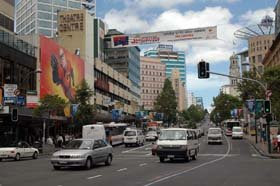
When we walk down Queen Street in Auckland, we are walking atop one of the world's tallest mountains. Our own stunted perspectives hide that startling fact. We are tuned by evolution to only a tiny portion of what is going on around us, like a radio that can only listen to one station.

Take Gondwanaland, the supercontinent from which most of today’s southern hemisphere descended. It formed over 500 million years ago. Over time it split up into chunks. A mere 80 millions years ago one of those chunks began its slow trek southwestward to what we now call New Zealand. Today it is traveling north again—at the phenomenal rate of an inch and a half a year. The Polynesian triangle is disappearing. Momentarily—at least in geological time—the triangle will be reduced to a straight line. All this frenetic geological activity is lost to us. Our perspectives are simply too limited.

Here is something else we cannot see. The average height of land throughout the world is 2,854 feet compared with the average depth of the sea, which is 7,273 feet. (I am indebted to Melanie Stiassny, Curator of Fish at the American Museum of Natural History in New York for opening my eyes to this startling fact.) By rights the earthen world is roughly 5,000 feet below the level of the sea world. Earth should be called Water, though given the present level of human interaction perhaps Fire is a better name than either.

It is astonishing to think that pushed back in time all the landmasses of the southern hemisphere would fit together like the pieces of a picture puzzle where the picture is Gondwanaland, the ancient mother that spawned them—South America, Africa, India, Australia, Antarctica and among the smallest of them, New Zealand.

We owe that vision to Alfred Wegener, the man who first propounded the notion of continental drift in 1915. His views were held to be absurd by the mainly North American geologists of the time. He couldn’t come up with a plausible engine to push the continents around. His visionary theory died aborning and wasn't resurrected until twenty years after his death. Being right is often not good enough. All you had to do was look at South America and Africa to see that, save for an intervening ocean, the continents were spooning one another.

Why didn’t his colleagues rally around him? Why didn’t they try to prove he was right instead of doing their level best to prove him wrong? There is always a vested interest in the status quo even in science. It enables those with power to stay in power. But it is also partly due to humankind’s reluctance to change. For some reason change threatens us. If things aren't the same tomorrow as they are today, then something is dreadfully amiss. Entrepreneurs have made fortunes on this principle. Think of hotel chains like the Holiday Inn. They sell sameness. People buy it. The current struggle between evolution and creationism is really about that. Creationists tout a theory without change. It is comforting. Evolution, the embodiment of change, couldn’t be more threatening.

Perhaps we know we are blind to the universe we live in. Perhaps that is what has made us so cautious.

Click here to listen to this entry in audio

Hail to the Chiefs

At the Maori Arts and Crafts Institute Mai, our guide, instructs us in a greeting ritual that we must perform before we may enter the marae, a sacred house of the Maori. The essentials of the ritual are these. We must designate two chiefs. Neville Peat is one. I am the other. Mai will stand between us at the beginning of a walkway that leads up to the entrance to the marae. My traveling companions are to line up behind. We are meant to think of ourselves as villagers and their chiefs paying a visit to a neighboring village. We must assure the host village that our intentions are peaceful.

A warrior comes out to test our intentions. He performs a fierce dance, replete with popping eyes and a protruding tongue. He wields a fighting stick. We must watch him without any trace of emotion.

The warrior throws down a branch. Neville and I move forward. We must never take our eyes off the warrior. We are to pick up the branch and back away. The picking up of the branch and the backing away is taken as a sign of our peaceful intentions.

Apparently we have gotten our non-violent message across. Mai instructs us to advance along the walkway. When we reach the steps of the marae, we take off our shoes and enter. Neville and I are told to sit at the front where we shall each deliver speeches in response to the Maori speeches to us. Neville goes first and speaks entirely in Maori. I follow and deliver a speech, partially in Maori, thanks to Neville's help, and partially in English. Here is what I say:

Rangatira maa 'chiefs and others'

tangata whenua 'people of the land'

Teenaa koutou katoa 'greeting to you all'

Nga mihi nui kia koutou 'warm greetings to you'

Kia kaha, kia toa, kia manawanui.

'Be strong, be brave, persevere.'

The Maori warriors to whom I address my greeting don't know what to make of it. They sit there politely, attentively and, I suspect, anxious for the ordeal to be over.

At lunch we have sweet-potato soup. The sweet potato or kumara originated in South America. How did it get to Polynesia? There are two possibilities. Either the Polynesians originated in South America and left there with the kumara to settle in the great Polynesian triangle of New Zealand, Hawaii and Easter Island. Or else, they started in the triangle, sailed to South America and returned with the kumara. Michael King thinks the latter story the most likely. I follow him.

Last night the sea was rolling. We took seasick pills and hunkered down in our cabins protected from the swells by thousands of tons of steel. Compare that to the ancient Polynesians who made their way across this same ocean in open outrigger canoes, some big enough to hold 100 people or more. They didn't know where they were going, driven in part by a sense that their ancestors had always found land and so, too, would they.

Tonight the ship is rolling even more thanks to 10 ft. swells produced by a low that has been hanging over New Caldonia for several days. After dinner, I go to the promenade deck. The swells have increased in size. The ship is beginning to play seesaw with the water. The ship's wake is phosphorescing just beyond the railing, a miniature sky in the water.

Back in my cabin falling asleep was not a problem. Staying asleep was another matter. I remember reading in Francis Chichester's Along the Clipper Way that one wave in every 132,000 will be four times the height of the average wave. I think the 40-footer must have hit around 2am. That was when the cabin’s refrigerator joined me in bed.

Click here to listen to this entry in audio